
Executive Summary
Methane (CH4) is a potent greenhouse gas that causes a direct radiative forcing effect. With a mean residence time of 12 years in the atmosphere, the global warming potential of methane is at least 80 times higher than CO2 over 20 years and 27 times higher over 100 years. Despite its short residence time, anthropogenic methane emissions contribute to around 25% of global warming. Overall, more than half of global methane emissions stem from anthropogenic sources, namely agriculture (40%), fossil fuel processing (35%), waste management (20%), and biomass combustion (5%). The present white paper investigates methane emissions from flame curtain pyrolysis (i.e., artisan biochar production) and open biomass burning, aiming to quantify emission factors and provide recommendations to reduce these crucial emissions.
In general, methane can be produced through both biological and thermochemical processes. While biological methane production is typically associated with anaerobic decomposition, thermochemical methane formation occurs during combustion and pyrolysis. This study focuses on the latter, where methane is a product of incomplete combustion of biomass.
When biomass is heated to elevated temperatures (> 200 °C), it releases flammable volatiles such as carbon monoxide (CO), hydrogen (H2), and light hydrocarbons (CxHy) like CH4. When these volatiles compounds are oxidized (e.g., by passing through a fire zone), the resulting products are CO2 and H2O. However, if the combustion of the released volatiles is incomplete, molecules like CH4 and CO are emitted into the atmosphere. During flame curtain pyrolysis or an open biomass burning event, factors such as low gas temperatures and limited oxygen supply may prevent the full combustion of volatiles (and thus the oxidation of these gases to CO2) and cause significant methane emissions. Higher feedstock moisture further prolongs drying and devolatilization, lowers burning temperatures, and may hinder combustion, potentially enhancing smoldering and increasing CO and CH4 emissions.
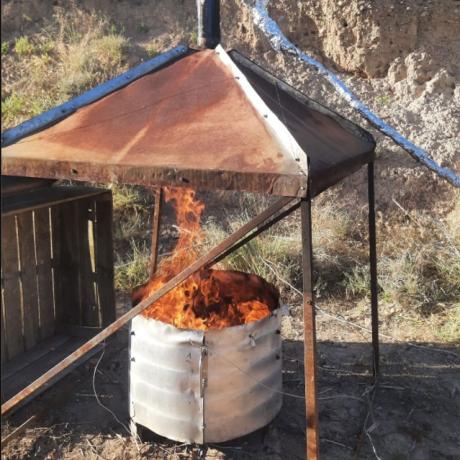
In pyrolysis biomass is heated under the near absence of oxygen to temperatures above 350 °C. It is applied to traditional and modern charcoal and biochar making. A special pyrolysis technique used in artisan biochar making is the flame-curtain pyrolysis. In this typical artisan biochar production, feedstock is added and pyrolyzed layer by layer in an open kiln (i.e., the Kon-Tiki) heated by a covering flame curtain. The flame curtain above the pyrolyzing feedstock consumes the oxygen from the air, creating oxygen-starved pyrolysis conditions below the flame curtain. Volatiles (i.e., the pyrolysis gas) emitted during the outgassing of the biomass-feedstock in the kiln are mostly burnt (to CO2 and H2O) when passing the fire carpet above the feedstock layers. However, not all volatiles are captured by the flame curtain. Some molecules, such as CH4 and CO, pass the flame zone unoxidized and are emitted to the atmosphere.
In the present white paper, we assessed the CH4, CO and CO2 emissions from Kon-Tiki pyrolysis for various feedstocks and moisture contents. The Kon-Tiki emissions were then compared with emissions that occurred when the same biomass feedstock was burned in an open setup to simulate open burning of crop residues.
When using the same feedstock, methane emissions of the Kon-Tiki were on average 36% lower than those from simulated open burning. Similarly, CO emissions decreased by 35% on average.
In general, methane emissions increased with increasing feedstock moisture content. Here we grouped feedstocks in three moisture content categories dry (≤ 15%), semi-moist (16-24%) and moist (≥25%). For dry and semi-moist feedstocks (moisture content < 25%), emission factors were significantly lower than the methane emission factor of 30 kg CH4 per ton of biochar, considered in the Global Artisan C-Sink Standard (CSI, 2024). For woody biomass with a moisture content below 25%, average emission factors were around 5 kg CH4 per ton of biochar. However, semi-moist wheat straw exhibited higher emissions, reaching up to 20 kg CH4 per ton of biochar. According to the extensive dataset collected for this study, only feedstocks with elevated moisture contents (> 25%) produced higher methane emissions, ranging from 30 to 40 kg CH4 per ton of biochar.
The presented data confirm the low Kon-Tiki emission factors described by Cornelissen et al. (2023) for dry feedstocks. However, the extremely high methane emission factor that Cornelissen et al. (2023) found for wet feedstock (twigs and leaves) could not be confirmed; they were an order of magnitude higher than the highest emissions measured from the wettest feedstock (giant reed).
The moisture content of the feedstock emerged as the most critical factor influencing methane emissions during the Kon-Tiki process. The kiln’s flue gas temperature also offers valuable process insights. Continuous flue gas temperature monitoring can be used for methane emission factor monitoring, The moisture content of the feedstock is particularly crucial because it directly affects the combustion process and, thus, the temperature profile.
Biomass with low moisture content allows for a more complete combustion, whereas higher moisture levels prevent the full combustion of volatile compounds. The feedstock moisture must first evaporate before the main pyrolysis reactions can set in. Water evaporation consumes heat and lowers temperatures through evaporative cooling. Additionally, the formation of steam obstructs the efficient mixing of combustion air (i.e., oxygen) with the rising pyrolysis gas. As a result, a portion of the released methane is emitted without being oxidized to CO2.
To ensure low methane emissions, the feedstock must be thoroughly dried. The feedstock moisture content should either be monitored directly using biomass moisture analysis or indirectly via continuous flue gas temperature monitoring. This approach will optimize flame curtain pyrolysis and minimize methane emissions. With very dry feedstock (< 15% moisture content), CH4 emissions were always below 5 kg CH4 per ton of biochar, significantly lower than the default value of the Global Artisan C-Sink Standard.
5 kg CH4 per ton of biochar, representing the global warming potential of 400 kg CO2e over 20 years (versus a carbon sink of circa 2000 kg CO2e) can be compensated by the semi-persistent carbon (SPC) fraction of a Kon-Tiki biochar or by planting trees and maintaining their growth for at least 20 years.
The present White Paper is based on Methane Emissions From Flame Curtain Pyrolysis (Kon-Tiki) published 2026 in the Journal Global Change Biology and Bioenergy by Lotz et al. (https://onlinelibrary.wiley.com/doi/10.1111/gcbb.70108).
Download here the print version of the complete White Paper on Kon-Tiki emissions.
- Please write us your comment -
×