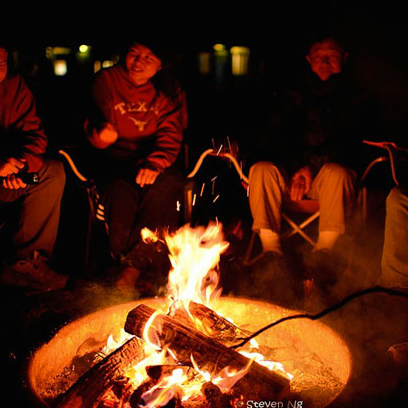
Campfire Lessons - breaking down the combustion process to understand biochar production
By Mark R. Fuchs, M. Garcia-Perez, P. Small and G. Flora
The authors
Mark Fuchs is a hydrogeologist and manager of the Department of Ecology's Waste to Fuels Technology (WTFT) research projects. WTFT research is designed to lead to practical applications for recycled organic feedstocks and has grown to include a basic suite of biorefinery technologies: anaerobic digestion of food and green waste resources for bio-methane, nitrogen and phosphorous fertilizer recovery, thermal processing of woody biomass from land clearing and demolition and deconstruction resources for fuels, heat and power, and biochar, composting, and carbon dioxide stack capture for use in green houses, or algae production. The WTFT project also supports technology transfer through extension and outreach to the organic recycling industry creating supporting business opportunities, jobs and renewable energy that benefits people in the state of Washington. The research is done through a partnership agreement between Ecology and Washington State University’s Center for Sustaining Agriculture and Natural Resources.
Manuel Garcia-Perez is an associate professor in the Department Biological Systems Engineering at Washington State University in Pullman. He works in fundamental studies to understand cellulose and lignin pyrolysis mechanisms and the development of selective pyrolysis reactors and bio-refinery concepts to convert bio-oils into bio-fuels and bio-chemicals and to engineer biochar for specific applications. Manuel directs thermo-chemical biorefinery research under the Ecology-WSU partnership agreement.
Phil Small is a consulting soil scientist and owner of Land Profile, Inc (http://landprofile.com). Phil has 36 years experience in environmental and agricultural soil science. He has been making and working with biochar since 2005. He is a permaculture enthusiast, and serves on the board of the Inland Northwest Permaculture Guild.
Gloria Flora was one of the first women to achieve the level of Forest Supervisor in the US Forest Service. She is known for her courageous 1997 decision that denied the oil and gas industry access to drill on national forest lands on the Rocky Mountain Front. Trained as a landscape architect, Gloria understands the importance of the human relationship to our public landscapes. She is the Director of Sustainable Obtainable Solutions, a nonprofit dedicated to the sustainability of public lands and of the plants, animals and communities that depend on them. She is also the director of the US Biochar Initiative (http://biochar-us.org).
The reviewer
Catherine Brewer is an assistant professor in the Department of Chemical & Materials Engineering at New Mexico State University in Las Cruces, NM, USA. Catherine did her PhD work at Iowa State under pyrolysis expert Dr. Robert Brown. She has a passion for thermochemical conversion, biomass utilization, waste valorization, biochar characterization and communicating biochar science to non-scientists.
Reviewer comment
Catherine Brewer:
One of the frequent challenges experienced by members of the biochar community is figuring out how to explain biochar and biomass thermochemical processes to friends and family members. The authors’ use of the campfire illustration is so helpful because it is familiar to a wide audience and scientifically accurate at the same time. After hearing this illustration the first time myself, I remember thinking, “I will never again see just a campfire.”
Further readings
Washington Department of Ecology and Washington State University’s Center for Sustaining Agriculture and Natural Resources partners conduct work directed by the Washington State Legislature. These collaborators provide technical assistance to the organics industry and have produced numerous project and biennial reports.
Selected Project Reports from the Washington Department of Ecology and Washington State University
Garcia-Perez, M, and J. Metcalf, 2008. The Formation of Polyaromatic Hydrocarbons and Dioxins During Pyrolysis: A Review of the Literature with Descriptions of Biomass Composition, Fast Pyrolysis Technologies and Thermochemical Reactions (link here)
Methods for Producing Biochar and Advanced Biofuels in Washington State. Multi-part study by Manuel Garcia-Perez with contributions from graduate students, staff and reviewers:
Part 1: Literature Review of Pyrolysis Reactors, 2011. This report reviews the technologies that have been developed for kilns, retorts and pyrolysers. Ecology pub. no. 11-07-017 (link here).
Part 2: Literature Review of the Biomass Supply Chain and Preprocessing Technologies, (From Field to Pyrolysis Reactor), 2012. This report reviews biomass sources, collection, and pretreatment. Ecology pub. no. 12-07-033 (link here).
Part 3: Literature Review of Technologies for Product Collection and Refining, 2012. The report describes technologies and methods for bio-oil products recovery and characterization, biochar activation, bio-oil refining strategies and regulatory issues related with deployment of pyrolysis technologies. Ecology pub. no. 12-07-034 (link here).
Part 4: Literature Review of Sustainability Goals, Business Models, and Economic Analyses, 2013. This report focuses on the criteria that need to be followed to integrate thermal process technologies into sustainable business models. This last report presents sustainability criteria and several business models that could be used to build sustainable enterprises based on biomass pyrolysis technologies. Ecology pub. no. 12-07-035 (link here).
Frear, et al., 2005. Biomass Inventory and Bioenergy Asessment (link here).
Frear, et al., 2012. Two Novel Floor Scale Anaerobic Digesters. Ecology pub. no. 12-07-036 (link here).
Frear, et al., 2013. Odor in Commercial Scale Compost: Literature Review and Critical Analysis. Ecology pub. no. 13-07-066 (link here).
Frear, et al., 2013. Applied Research and Extension for Second-Generation Organic Waste Processing: High Solids Anaerobic Digestion, Nutrient Recovery, and Pyrolysis. Ecology pub. no. 14-07-010 (link here).
Fuchs, et al., 2012. Biochar: Background & Early Steps to Market Development. Ecology pub. No. 12-07-067 (link here).
What is it worth for you that this article exists? All of our articles are open source, based on experience and scientific research, reviewed by renowned scientists, independent and free from ads. Please help support our work with a subscription to the Biochar Journal. Subscribe here.
Please cite as:
Fuchs M, Garcia-Perez M, Small P, Flora G: Campfire Lessons - breaking down the combustion process to understand biochar production,
the Biochar Journal 2014, Arbaz, Switzerland. ISSN 2297-1114
www.biochar-journal.org/en/ct/47
Version of 31 th December 2014 Accessed: 02.04.2026